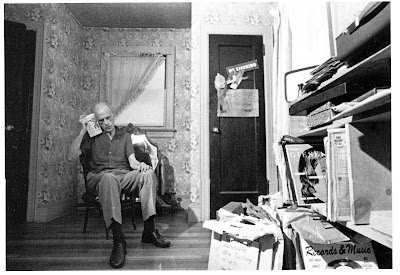
Tuesday, April 01, 2008

pen umbra


An Objective: (Optics) - The lens bringing rays from an object to a focus. That which is aimed at. (Use extended to poetry) -
(Zukofsky)

*


Creative filing
Creative arranging
as poetics
as technique
as joyous creation

(Joseph Cornell, 3/3/59 for week ago 2/24/59)

*

I fall into the usual trap & procedures: research. I dig into Cornell's biography, start planning a reading programme - James, Hawthorne, Melville, Astronomy textbooks - ... I'm already looking at a three year, no, a lifetime's project.

I feel jammed. How do I explain l-o-g-i-c-a-l-l-y what I am trying to do? I can't! AND THAT IS THE POINT.

Predictable despondency ensues. I'm not up to the job, I can't do it, I haven't the time, why didn't I pay attention in 'O' level Physics?

& then, just as Robert comes (leaking toilet on the first floor - we need a new joint and mechanism) I realise: as Peter Gizzi says in an interview "doubt is generative". i.e. precisely because I DON'T KNOW so I have the position from which to begin.

*

"it should be said rather that the most complicated standards of science - including definitions, laws of nature and theoretic constructions - are poetic ... " (Zukofsky)

Saturday, March 29, 2008

Today (yesterday)

http://www.bbc.co.uk/radio4/today/rams/20080328_charlotte_giggles.ram

One of those great moments on British radio when the facade cracks for a few seconds ...

Thursday, March 27, 2008

Etymological thinking


"... the 'Repository' or the 'Laboratory' (or 'Elaboratory') ... "

(Ashmolean museum card)

Wednesday, March 26, 2008

Consumer Research


Just gone through the Poetry sections of Blackwells and Borders in Oxford and there is NOTHING worth buying. I go on Amazon and order i) the Complete Stories of Arthur C. Clarke,ii) a bumper Cornell volume and iii) the Scroggins 'Zukofsky'.

Then we go to the Science Museum (the old Ashmolean) and look at astrolabes and other scientific stuff. I'm thinking about Joseph Cornell.

Tonight's DVD: Le Fabuleux destin d'Amélie Poulain. Truffaut meets Proust.

And here's an advert for Crossroads Garage of Kidlington and an anti-advert for Yateley Motors and the Renault garages in the Farnborough-Fleet area. When you want your boot lock repaired go to CROSSROADS!

Friday, March 21, 2008

UK visit

As I write, through the window swirls of snow or is it Cherry Blossom? The strangest changeable weather.

*

Spend this morning reading The Cambridge Guide to the Solar System and odd pages from Theatre of the Mind (Mary Ann Caws' edition of Cornell's diaries and letters) a book I return to again and again.

This sends me upstairs in search of my copy of Marianne Moore's poems. Here's a lovely one that caught Cornell's eye - one can see why (Faber print the second and third lines of each verse indented):

NEVERTHELESS

you've seen a strawberry
that's had a struggle; yet
was, where the fragments met,

a hedgehog or a star-
fish for the multitude
of seeds. What better food

than apple seeds - the fruit
within the fruit - locked in
like counter-curved twin

hazelnuts? Frost that kills
the little rubber-plant -
leaves of kok-sagyyz-stalks, can't

harm the roots; they still grow
in frozen ground. Once where
there was a prickley-pear -

leaf clinging to a barbed wire,
a root shot down to grow
in earth two feet below;

as carrots from mandrakes
or a ram's-horn root some-
times. Victory won't come

to me unless I go
to it; a grape tendril
ties a knot in knots till

knotted thirty times - so
the bound twig that's under-
gone and over-gone, can't stir.

The weak overcomes its
menace, the strong over-
comes itself. What is there

like fortitude! What sap
went through that little thread
to make the cherry red!

*

Tomorrow morning Belgianwaffle goes on the road with the wife, kids and Macbook. The delights of Easter snow, traffic hold-ups and tasteless coffee in half-pint cups await in England! Whoopee!

Posts are liable to be back to the unreliable 'normal service' of February and before. (Unless we find a Wi-fi hot spot).

*

bright sunshine and blue skies. 12:25pm. Weird.

Thursday, March 20, 2008

Penny Arcadia


(Joseph Cornell 'listening' to a book, c. 1970)

Who has got close? Peter Gizzi in his series 'Locket'; Elisabeth Willis in The Human Abstract; Brian Catling, maybe. Those are the ones who strike a chord with me. Yet there's one more - perhaps the secret key to unlock the boxes - Emily Dickinson. "The thought beneath so slight a film", "soundless dots - on a Disc of Snow - " , "A sphere of simple Green", "An hour in Chrysalis to pass" ... lines like these continue to vibrate.

***

These are notes transcribed from a couple of summers ago. Writing off, away from, Cornell's boxes themselves and Rosmarie Waldrop's texts. I am fascinated by the boxes (of course) but also the archive Cornell assembled: dossiers, files, shoeboxes. Then there is the mass of scribbled notes, diary entries, sightings, 'extensions'.

The challenge - as I see it - is not so much translate the content. Instead, it is to find an equivalent method. A glass, a marble, a metal ring, a cut out of a parrot from a magazine, a Boys' Own diagram of the solar system, a lock of hair.

Paragraph units seem appropriate. Reading through these notes I see how much depends upon punning association. In fact, I think it might be more appropriate to juxtapose sounds: as Cornell sets dissimilar objects together to make them sound. Juxtaposition and arrangement certainly seem to be the way to go. I'm open for suggestions.

***

i

Four sentences. Four lines. Each line is a frame. A frame-up. Four by four by four. The cube route. Go fourth and multiply yourself.

ii

You are in the cross-sights. ⊕ . Perspective puts you in the picture. The eye around which it all circles. Eye-I by now a commonplace. Vanishing point. Everything flees from me.

iii

Naval and navel. Navigation of the waves which ripple constructively and destructively from my being. Circumnavigate mistaken for circumcision. My bull’s eye. Target. ‘Ex’ marks the spot. Unbelievable. Umbilical.

iv

Waves of sound, light, water.

v

Seismograph boxes. Seemingly fixed and stable, immovable, and yet sensitive to imperceptible tremors (here) but vast tectonic movements (there).

vi

Telescope boxes. Ways of sighting tiny specks of light which are vast burning masses of energy. The ‘now’ of seeing light years away from the source. Orbits, eclipses, returns, constellations. A bus schedule ephemeris. There’ll be another one along shortly. There are no corners in space to come around.

vii

Imagine of the stars came out only once in a hundred years. Who said that? Emerson? Thoreau?

viii

The language of mathematics. Line, curve, demonstration, proof, logic.

ix

The egg and its energies. Latent and developing. And the shell.

x

All that light exceeding me. Arcadia (Sidney) and Urania. Look away from the sun to see what it illumines.

xi

Box as trap. Imprison the viewer. Take you in. You are one among objects. To assemble resemblance of what?

xii

Scale & purpose? Elgin marbles. Children’s marbles which roll behind the sofa and between the cushions. Globes. Emersonian circles. The transparent eyeball. Harmony of the spheres. “What discord when planets to disorder wander ...” (Troilus and Cressida)

xiii

Voice box. Echo box. Loudspeakers. Amplifiers. Radio sets. Crystal sets. Transmitters. Receivers. Wave lengths? Stations? The World Service. Ear as well as the eye Black box. The last minutes of voices in distress. “We’re going down ...”. Air traffic copntrol loses sight. How many voices on board?

xiv

Disconcerting intimacies. Lick. Fur. Tickle. Tongue. Breath. Lip. Stroke. Shudder.

xv

The cabinets reflect. Your face looking out. “Your” contains “our”. Photo of Cornell looking at his own reflection (by Hans Namuth 1970). Cabinets of Curiosity. Jekyll & Hyde. “... marked E ... folded paper ...”. Means for self-transformation.

xvi

All books are secondhand. In movement in time. A watch seems to stop, then the hand moves.

xvii

All books are secondhand. Belong to someone else before & after & during. No such thing as a blank page. “The blank page is not blank”.

xviii

Intelligent collaborators. War-time interzones. A message is passed, left, picked up surreptitiously. The Third Man. (those notes? – April-July 05 red nbk) Cocteau’s ‘Orphee’ & radio broadcasts. Orpheus as double agent ‘above’ ground and in the Underworld. Jack Spicer. Poetry as broadcasts. Wallace Berman’s transistors.

xix

When statement contains understatement. One sentence looks for another. Echo. Confirmation. Double vision. Squint. Cross your i’s and dot your t’s. I cross.

xx

How many of these sentences are echoes? After images. Ex-cited? Trailing their birth chords/cords? From whose matrix? Womb threads. The spin doctor. Scratch yourself on the mix. Historical events are always intimtae for someone. Again persepective. Now, then. Retrospect objectifies. First hand accounts. Eye witness.

xxi

Recurrent image of the ship voyaging across the waves. Rimes of ancient seamen. Ulysses. Oily seas. Coleridge. Baudelaire. Melville.

xxii

Image of high fidelity. The point around which we orbit. Pin & stylus. Dig the groove, man. Time lapse photo of the skies. Immense tracks of the stars circling above our heads. Send your head spinning. His Master’s Voice.

xxiii

At hand. At arm’s length. As far as I can throw it. One foot. The distance of an inch: between the tip and the first joint of the thumb. Out of sight. Within hearing. Rub your nose in it. On the tip of my tongue. Put my finger on it. Hair’s breadth. Pubic space & public space.

xxiv

At sea in language. Twefth Night. Salty solutions. Brine. Preserving love with tears. Viola. Olivia. Anagrams and twins. Jumbled letters. Alphabet soup from which our being is made. A-n-d/D-N-A. Conjunctions.

xxv

Shipwrecks. Oceanic memories & birth trauma. Boxes cast up on shore. The Piano. Wreckers. Drowning in language. Titanic. Man overboard. Scaling the high Cs.

xxvi

Footnote to the text equivalent to antique dealer’s provenance. Where is the value of a sentence to be located? On the back of the canvas? An accompanying letter (correspondence)? A photo of Mr X holding the cup with the King of - ? The signature looked genuine. The inscription. Hallmark. Another sign. Where does it end?

xxvii

Cornell’s dossiers. His archives. His extensions . What is in the box? The box as an attempt to shut the endless proliferation of sense? Pandora’s box in reverse. Once they’re sealed what apocalypse is unleashed? Apo + calyptos. Cut it out. Cut-outs. Time stalled.

xxix

There is – sometimes – a logic (unlogic?) that takes over. Dictates each sentence. Working between texts. Corresponding through putting your ear to the page. Photo of Cornell with a book to his ear (Hans Namuth c.1970).

xxx

A theoretical experiment (they call it a ‘thought experiment’) in which something occurs between two boxes even though they do not have any direct means of communication. A ‘jump’. The magician’s sleight of hand. How the electron acquires a different charge or ‘spin’.

xxxi

Suitcase. Travel belongings. Going through customs. Anything to declare? X-ray of a toothbrush, underpants, socks. See through nighties. The 100 per cent genuine leather hide. Border crossing. Passepartout. Passport.

xxxii

Story of a door. When is a door not a door? When it is a deaf ear. Dr J and Mr H. How to get back in when you’re not yourself. Sending myself a letter.

xxxiii

Overdetermination of names. Or what Freud calls condensation. Annette. Listen: a net. Rosmarie Waldrop. Mary Rose. Her name an interesting telescoping of a sunken ship. Valery on poems and shipwrecks. Wall drop. The barrier comes down.

xxxiv

Fairy stories – Cinderella. If the shoe fits. False translation: glass slipper. Transformation at midnight. Putting yourself in someone else’s shoes. Phallicism of sheathing. Menstruation. Slips. Slippers. Poe’s raven. “Nevermore” versus “ever more” versus “once upon a time” versus “happily ever after”. Mother. The step mother replacement. Substitution. Penny in the slot. The penny drops. Arcade and arcadia. Penelope.

xxxv

i-m-a-g-i-n-e = e-n-i-g-m-a + I

xxxvi

Within one sentence the impression of a sudden warp. We’ve gone from ‘this’ to ‘this’ but no jump signalled. At what point – exactly – do we shift? Time warps – Dr Who – and those notes?

xxxvii

Cornell’s boxes are deceptively ‘present’. Each object haunted by its original context. Which was? The physical object empties itself. You hear quotation marks around it. At home in eviction.

xxxviii

My earlier thoughts on Cornell’s glasses – in fact in flux – the slow flow of liquid which is glass. Transparent. Eternal – in what sense? They lived happily ever after – and then?

Wednesday, March 19, 2008

Plus ...

... thoughts on Joseph Cornell.

(It's a good job the Easter holidays begin tomorrow.)

Pipped at the post ...

Synchronicity or what? No sooner do I start sharpening my keyboard in anticipation of an entry on Raworth & Comedy, than I see this link on Ron Silliman’s Blog : http://davidcaddy.blogspot.com/2008/03/letter-11.html . David Caddy is hitting all the right targets so I don’t need to launch a long post. Tonight I’ll aim for brevity and postpone the Hancock-Raworth post until later. By way of thoughts on Caddy's post:

1. The number of Goon Shows which were based upon pastiche, parody and blatant appropriation. Clearly, Milligan used – and assumed – references, allusions, quotations from a shared pool of films, texts and songs. Furthermore, the power of radio at that period to hold an audience. Transferring to British poetry of the 50s and 60s what – who – would be the equivalents?

2. I love the ‘aural space’ of The Goon Shows. As radio shows they succeed to the extent that you do not see. Language and sound create a world operating on parallel logics. A sequence such as this from The Great String Robberies:

Scot No.1:
You see that piece of string on the table?

Seagoon:
Yes. What's that space in the middle?

Scot No.1:
That's the piece that's missing.

Seagoon:
So! So that's what a piece of missing string looks like, eh? Where's it gone? Ah! [laughs] But wait... can't you see, you, you poor Scottish fool!

Scot No.1:
[Gnashing teeth sounds]

Seagoon:
It's all, it's all a practical joke!

Scot No.1:
[Gnashing teeth sounds]

Seagoon:
Someone's cut that string in the center, pulled the two pieces in opposite directions, giving the impression that a piece had been removed from the middle.

Scot No.1:
Hairy gringlers, he's right! Och, it's true! If you put these two pieces together, the gap disappears!

Scot No.2:
Aye, but did you notice when you did that, the two outside ends got shorter?

Seagoon:
Gad... Gad, Chisolm's right! Now I see what happened. What cunning! [laughs] The criminal's cut a piece off each end, then cut across the middle pulled them apart, making the string look the original length.

Scot No.1:
Oh dear, this makes it a baffling case.

Scot No.2:
Aye.

Seagoon:
Ah yes. Instead of one piece we're looking for two separate ends... It's a good job I can count! [laughs] We must start investigations at once!

Dizzying!

3. Tape. What Milligan seems to have grasped – more than any of the BBC comedy writers of the time – was the extraordinary possibilities of recording. It just so happens this month’s Wire magazine runs a review of William Burroughs’ ‘Real English Tea Made Here’ CD. I quote:

“By treating the tape recorder as “an externalized section of the human nervous sytem”, Burroughs was definitely in sync with prevailing attitudes. From the 1950s through to the 1960s and beyond, there was a tendency to treat magnetic tape as an analogue for human consciousness as it existed in time …” (Ken Hollings, p54)

What David Caddy observes about Raworth’s freeing of the constraints of a coherent self find their sonic equivalent in the voice (supposedly the index of presence) made ribbon speeded up, reversed, fast-forwarded, rewound, cut and spliced – the basic material of The Goon Shows. Sound/time becomes plastic, malleable, sculptural. I‘m thinking of Raworth’s early volume `The Relation Ship’ where the space of the page becomes a means to examine time and experience. I’m also thinking of 60s rock experimentation: George Martin with the Beatles and – more radically - Zappa with the Mothers of Invention on albums such as ‘Freak Out’ and ‘Lumpy Gravy’. In addition to the radio, which records was Raworth listening to I wonder? ("pause/ between the dropping/ of the record & the music" - 'The Others', The Relation Ship).

4. ‘Logbook’. So many of the poems in Raworth’s ‘Big Green Day’ seem to incorporate what David Caddy locates in terms of “Imperial illusions” – ‘North Africa Breakdown’ and ‘Who Is Hannibal’s Descendant Leading His Elephants Against The Tanks?’ to mention just two titles. However, the work which prompted me to first think of Goon Show echoes is ‘Logbook’ (1970). Listen to this:

“At night in the forest we slept, listening to the creak of our future oars. “Let us”, said one of the natives whose language we could speak, but imperfectly, “build from these trees a thing we call a ‘ship’ – from the wood remaining I will show you how to make ‘paper’ – on this ‘paper’ (once we set sail) I shall show you how to ‘write’ (with a charred twig from the same tree) – and if your grandmother is with you, here’s how we suck eggs.” From the shore we watched the ‘ship’ approach us. We set sail in a small craft to meet the strangers, pausing only to write pages 106, 291, 298, 301, 345, 356, 399, 444 & 453 of the logbook, charring … “

as if read by Neddy Seagoon, imagining next the discovery of Grytpype Thynne and Moriarity as stowaways with Bluebottle approaching in a paper ship made out of an old copy of the Daily Mail.

5. “We never analysed it. I suppose it was an oral cartoon.I read once there were shades of Kafka, Ionesco and Dylan Thomas in it. Really it was just three blokes having a laugh, coupled with Spike’s inventive genius.” (Harry Secombe interviewed 1972).

“Basically I make things I like to look at, and I write things I like to read. There’s not much room outside that.” (Raworth interviewed by Ben Watson 2001).

Having made such identifications I immediately want to correct any impression of having ‘explained away’ Raworth’s poetry. One of the great charms of his work – for me, at least – is the way the poems remain defiantly on the page resisting translation into another discourse.

“too far. look back. you’ve missed the point”

(‘Love Poem’, from The Big Green Day - and the inability of my Blog formatting to cope with the original spacing of this line proves the point)

6. Um ... so much for "brevity".

Tuesday, March 18, 2008

Truly. Madly. Deeply.


There are films you watch and there are films you inhabit. And this was one of them.

That Anthony Minghella should have died after a "routine operation" seems a cruel irony given the plot of this film.

Clifton ... Bristol ... the early 1990s ... so many ghosts ...

Elevenses

Dear Walrus

A strange day at the chalk face in that the Server is down, e-mail stalled and students are occupied with exam presentations. So there’s a little space in which to breathe …

1. To read or write … yes, of course, it’s a false opposition. And yes, Deleuze gets it right (as so much – ‘Anti-Oedipus’ and ‘Thousand Plateaus’ were crucial texts for me in my twenties and I’m currently a big fan of his book on Nietzsche). I suppose it’s why I’m drawn to Duncan who so obviously incorporates reading into writing and – from my brief acquaintance with Duplessis – what I sense is going on in ‘Drafts’. To steal and adapt Beckett’s phrase: I’m after a form to accommodate the mesh (ie. the reading-writing-life weave). That said, I have things to shape and there are only so many hours in the day. And I am the Great Prevaricator (as if you haven’t guessed). Bernadette Mayer’s attitude was to make the choice. And there are the books to prove it. My experience is frequently that of walking up the ‘down’ escalator.
2. Whitman – yes. I’d dig further back to Emerson whose Essays I like enormously (and, I think, were very influential on Nietzsche). Susan Howe’s book on Emily Dickinson opens up lots of possibilities in terms of a Puritan tradition (Jonathan Edwards’ sermons, etc) and Bernadette Mayer has interesting things to say about Hawthorne and his influence upon American writing. I’ve yet to get into Hawthorne but Melville’s ‘Moby Dick’ has become a key text – see entries earlier in this Blog. I read the Whale as the Poem – well, you can work out the rest.
3. A mood of intellectual exile – that’s a fine phrase! And pretty bloody accurate. Obviously being in Belgium contributes to the feeling (dominant languages being French and Flemish, few English-language bookshops ((none of real quality)), even fewer like minded souls etc. – but let’s not get too Wertheresque). It’s also something about being in your mid-forties – any kind of passion above and beyond your career + mortgage + family looks increasingly suspect (“you mean you still have time for all that stuff?”). And I am happy to admit that just a few hours in England can make me yearn to be back across the Channel. So where does that leave me?

So, I’m very happy to maintain this correspondence – a Deleuzean ‘rhizome’ of sorts –and I’m really pleased that you find “lines of flight” leading off. I find the same in certain other Blogs – Kate Greenstreet’s ‘eod’ (now closed down) was a real inspiration: I loved the way she incorporated images and now and again gave a glimpse into her notebooks.

That’s about it for now.

In the next instalment: Tony Hancock, Tom Raworth and Modern British Poetry …

Deterritorialized yours

The Carpenter

Monday, March 17, 2008

Thank You

1.

A timely reminder ...

“Caution in writing and teaching. Whoever has once begun to write and felt the passion of writing in himself, learns from almost everything he does or experiences only what is communicable for a writer. He no longer thinks of himself but rather of the writer and his public. He wants insight, but not for his own use. Whoever is a teacher is usually incapable of doing anything of his own for his own good. He always thinks of the good of his pupils, and all new knowledge gladdens him only to the extent that he can teach it. Ultimately he regards himself as a throughfare of learning, and in general as a tool, so that he has lost seriousness about himself.”
(Nietzsche, ‘Human, All Too Human’)

2.

How silly of me ...

Where I understood One there were Two. Suddenly it all makes sense!

I am extremely grateful for your posts – they give me renewed energy and enthusiasm to continue blogging.

The image of David Hemmings in ‘Blow Up’ comes back to me: throwing the imaginary ball in the uncertainty of someone picking it up and the game continuing.


3.

distinctive
black ‘W’
obvious patch

the species
irrupts

birds
disperse

(the nest is well hidden
and made of small sticks

twigs
lined with
leaves ...

the letter
winged


4.

Enough for tonight.

April Fool?